Plein Watt Moto / Practical guides
Real Electric Dirt-Bike Range: How to Compare It
Checked
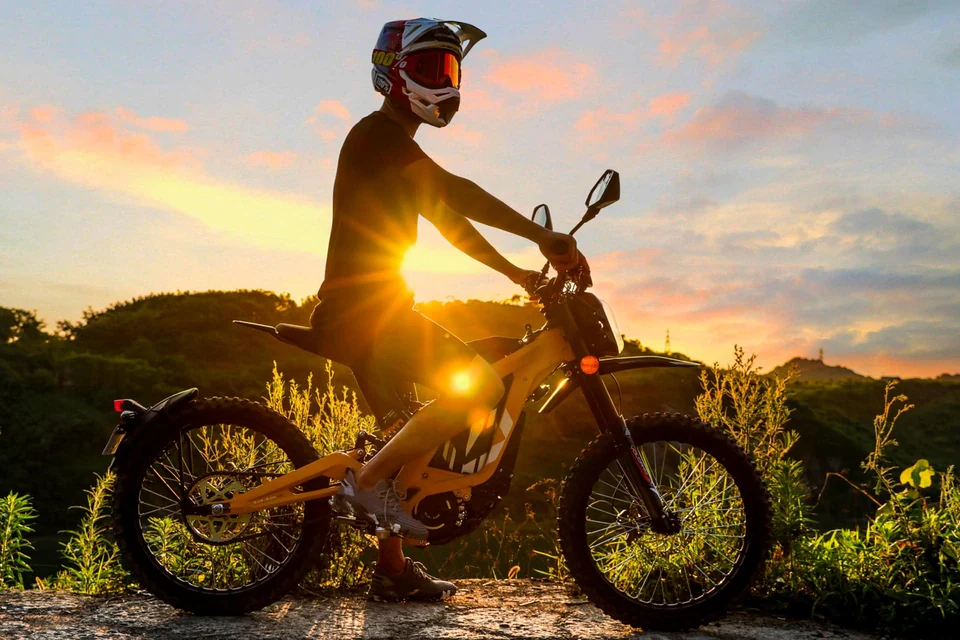
Understand kWh, speed, terrain, and reserve when reading Sur-Ron range claims and planning a realistic electric dirt-bike ride.
A distance needs a test protocol
“Up to 100 km” is not a complete description of electric motorcycle range. You need speed, terrain, rider weight, temperature, and the test’s stopping conditions to interpret it. Two manufacturers can quote very different distances without giving their motorcycles the same task.
Ask whether the measurement resembles your ride. Steady-speed travel does not describe a session with repeated acceleration and climbs. Sur-Ron’s FAQ identifies riding mode, throttle use, and terrain as range factors. We do not turn advertised distances into guarantees.
kW, kWh, and Ah describe different things
Kilowatts describe power. Kilowatt-hours describe an amount of energy. Amp-hours describe electrical capacity, which needs a voltage to estimate nominal energy. Multiply volts by amp-hours and divide by 1,000 to calculate nominal kWh.
For example, 72 V × 50 Ah gives 3.60 kWh. That does not mean all this energy is usable in every situation. Operating conditions and system management matter. The calculation is still useful for comparing the approximate size of batteries with different voltages.
A calculation example, not a riding test
Imagine 3,000 Wh of usable energy and average consumption of 50 Wh/km: theoretical distance is 60 km. At 75 Wh/km, the same energy gives 40 km. These numbers are intentionally hypothetical and describe no model in this magazine. They show how consumption changes distance.
For your own reference, record route, elevation, conditions, and charge change across several comparable rides. A short first outing with margin is more informative than a target taken from an advertisement. Avoid planning a return with no reserve, especially if the return route climbs or conditions change.
Compare bikes with context
Ask which protocol produced each range claim. Then look for reports identifying the version, with comparable riders and routes. A bigger battery holds more nominal energy; a heavier bike or faster riding may consume more of it.
Finally, check charging access, available time, and transport. A motorcycle that covers your session with a reasonable margin may fit better than one chosen only for the largest advertised number. Useful range is the range that matches your riding.
Sources and method
A documentary story. Sources for this issue were consulted September 18–19, 2026. Interpretations are editorial; cited creator tests are attributed to their authors. Plein Watt Moto does not claim to have conducted riding tests.